One Product, Three Stages, Three Standards
In Australia, explosives sign compliance isn’t governed by a single standard — as a matter of fact, it changes at each stage of the product’s life, from the moment it leaves the manufacturer to the moment it’s used at the charging face. Therefore, getting the signage right means knowing which instrument applies at each handover point.

The Three-Stage Compliance Journey
| Stage | Governing Instrument | Key Signage / Marking Requirement |
| Transport | Australian Code for the Transport of Explosives by Road and Rail (AEC), 3rd edition | Class 1 labels per AS 1216; segregation-barrier rules for mixed detonator/high-explosive loads |
| Storage | AS 2187.1 + state Explosives Act/Regulation (e.g. Qld Explosives Act 1999 / Explosives Regulation 2017) | Magazine sited, secured & signed; entrance notice of types & maximum quantities; security fencing |
| Use | AS 2187.2 + RSHQ Guidance Notes QGN10/QGN11 | Charging area & overnight sleepover warning signage and lighting |
Transport and Explosive Signs: The AEC, Not AS 1319

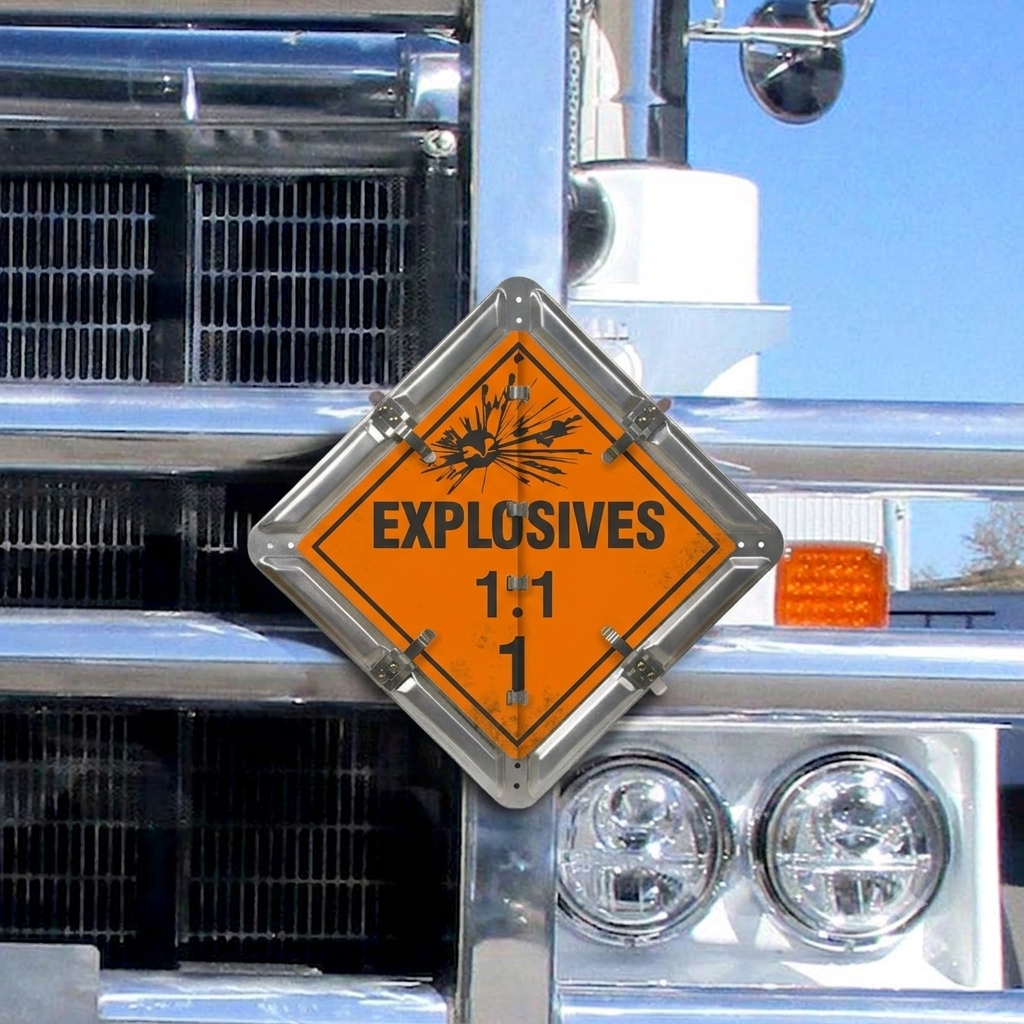
Explosives moved by road or rail are governed by the Australian Code for the Transport of Explosives by Road and Rail (AEC), 3rd edition — not the general AS 1319 occupational safety-sign standard. Vehicles require Class 1 labels compliant with AS 1216, and additionally, where a load mixes detonators with high explosives, segregation-barrier rules apply to keep the two physically separated in transit.
Storage and Explosive Signs: AS 2187.1 and State Explosives Law
Once explosives are held in a magazine, AS 2187.1 governs alongside the relevant state Explosives Act or Regulation — for example, the Queensland Explosives Act 1999 and Explosives Regulation 2017, or the equivalent instrument in other states. Requirements include correct siting and securing of the magazine, entrance signage noting the types and maximum quantities held, and security fencing.
Use: AS 2187.2 and RSHQ Guidance
At the point of use — on the charging face itself — AS 2187.2 applies, supplemented in Queensland by Resources Safety & Health Queensland Guidance Notes QGN10 and QGN11. Consequently, this stage brings its own signage obligations distinct from transport and storage: charging area warning signage, and overnight sleepover warning signage and lighting where crews remain on-site.
Detonator Segregation and Marking
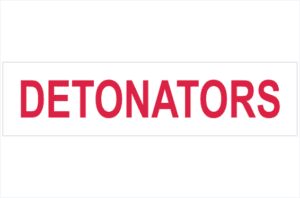
One requirement applies across all three stages: under AS 2187 and AEC marking clauses. You must stencil or emboss every detonator shell with the word “DETONATOR”. Generally this is one of the most commonly missed requirements in a site audit, alongside the segregation-barrier rule for mixed loads in transit.
Fireworks, Pyrotechnics and Defence-Sector Notes

Fireworks & Pyrotechnics: AS 2187.4 sets out requirements specific to fireworks storage and handling — related to, but distinct from, the AS 2187.1–.2 series covering commercial and mining explosives.
Defence sector: AS 2187.1 carries a Defence-sector exclusion. Operators working under Defence explosives ordnance protocols should confirm which instrument actually governs their site before applying the civil standard.
Frequently Asked Questions
Is AS 1319 the correct standard for explosives signs in Australia?
No. AS 1319 is the general occupational safety-sign standard. Explosives-specific signage sits under the AS 2187 series (specifically for storage and use) and the AEC, 3rd edition (transport).
What does the detonator marking rule require?
You must stencil or emboss every detonator shell with the word “DETONATOR”, under AS 2187 and AEC marking clauses, at every stage from transport through to use.
Do fireworks and pyrotechnics follow the same standard as mining explosives?
No. For fireworks and pyrotechnics you use AS 2187.4, a related but distinct standard from the AS 2187.1–.2 series used for commercial and mining explosives.
Does AS 2187.1 apply to Defence sites?
AS 2187.1 carries a Defence-sector exclusion. Defence sites and contractors operating under Defence explosives ordnance protocols should confirm the applicable governing instrument before assuming the civil standard applies. As a result, Australia, explosive signs on Defence sites may fall under different standards.
What signage is required at a charging area?
Charging areas require warning signage under AS 2187.2, supplemented by RSHQ Guidance Notes QGN10 and QGN11 in Queensland. In addition, where crews remain overnight, you will use sleepover warning signage and lighting.
Contact National Safety Signs
National Safety Signs Online Store and Retail Shopfront is based in South East Queensland and supplies safety signage, including Explosive signage, throughout Australia.
For enquiries, urgent orders, or bulk pricing:
- Phone: 07 5665 8996
- Australia-wide delivery available
- Express freight options available
- Buy online – https://nationalsafetysigns.com.au/
Why Choose National Safety Signs for your Explosives Signage in Australia?
Customers consistently leave positive reviews highlighting our signs’ durability, fast delivery, in addition to excellent customer service. From councils to construction companies, organisations across Australia trust us for reliable, high-quality safety signage.
“Thanks National Safety Signs for your signs, they arrived very quickly and were exactly what I needed!” — Rosemary. National Safety Signs
Google / Yably reviews rate the company 4.90/5 from around 400 reviews, highlighting product quality, fast delivery, and good customer service. Yably